
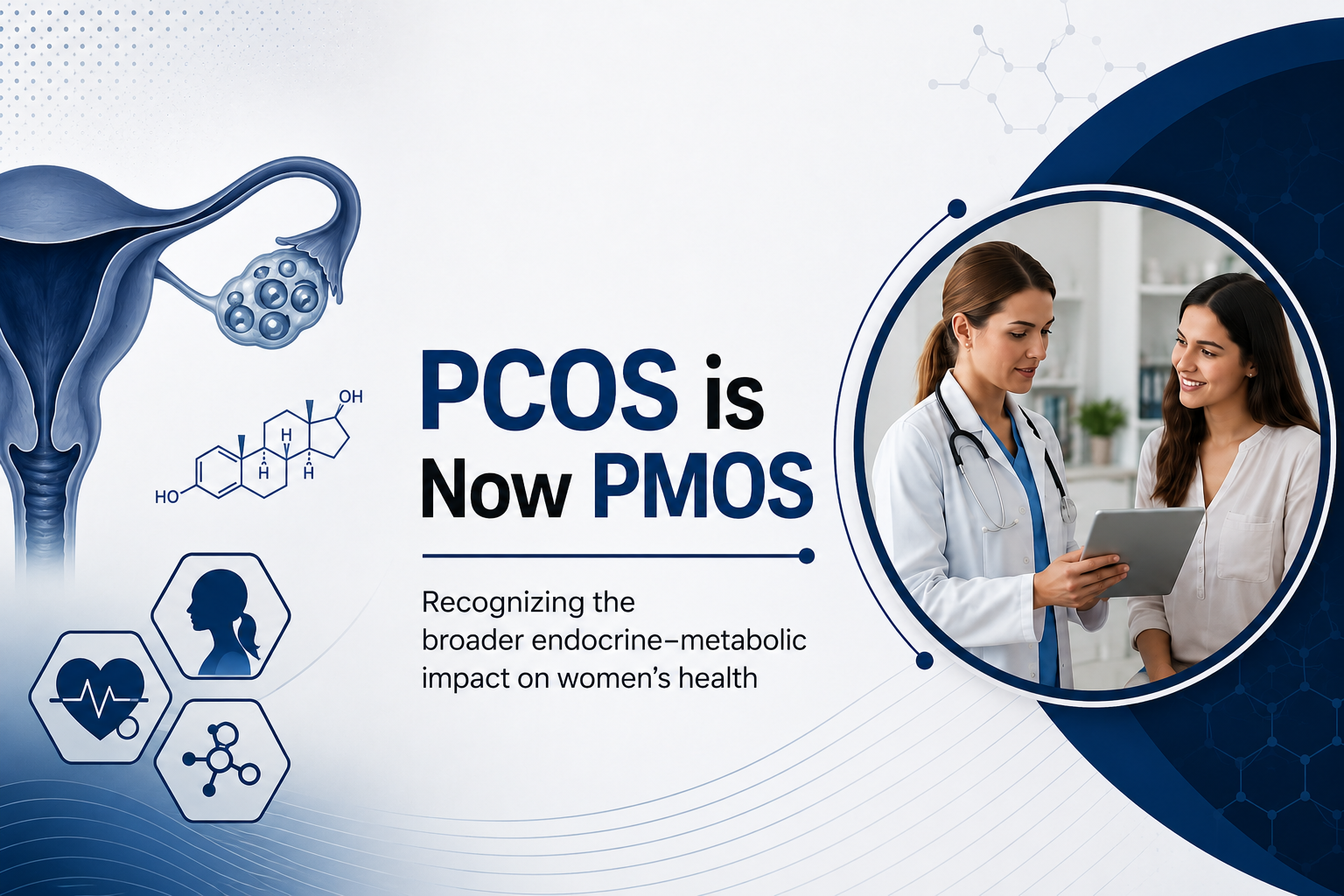
For decades, the condition known as Polycystic Ovary Syndrome was widely misunderstood due to its name. The term “polycystic ovary syndrome” suggested that the condition was mainly related to ovarian cysts, when in reality it is a far more complex hormonal and metabolic disorder affecting multiple systems throughout the body. In May 2026, a global consensus published in The Lancet officially introduced a new name for the condition: Polyendocrine Metabolic Ovarian Syndrome (PMOS). (The Lancet)
The new terminology was developed after more than a decade of international collaboration involving researchers, clinicians, patient advocacy groups, and thousands of women affected by the condition worldwide. Experts concluded that the previous name contributed to confusion, delayed diagnosis, fragmented treatment approaches, and social stigma. Many women were incorrectly reassured that they did not have the condition simply because no “cysts” were visible on ultrasound scans. (PubMed)
One of the most important reasons behind the renaming is the recognition that the so-called “cysts” seen in many patients are not true ovarian cysts. They are actually immature follicles that fail to complete normal ovulation. In many cases, women with PMOS may even have completely normal ovarian imaging while still experiencing significant hormonal and metabolic dysfunction. (The Guardian)
The new name better reflects the multisystem nature of the condition. The term “polyendocrine” highlights that several hormone systems are involved. “Metabolic” emphasizes the strong relationship between the condition and insulin resistance, weight regulation, glucose metabolism, and long-term cardiometabolic health. “Ovarian” recognizes the impact on ovulation, fertility, and reproductive health, while “syndrome” reflects the broad pattern of interconnected symptoms and clinical findings. (PubMed)
Research now shows that PMOS affects approximately one in eight women globally and is associated with much more than menstrual irregularities or fertility concerns. Women with PMOS may experience insulin resistance, increased risk of type 2 diabetes, abnormal cholesterol levels, fatty liver disease, cardiovascular risk factors, acne, hair thinning, excess facial or body hair growth, weight management difficulties, anxiety, depression, and long-term metabolic complications. (Vogue)
Another important shift in understanding PMOS is the growing focus on metabolic health and insulin resistance as central contributors to the condition. Elevated insulin levels can stimulate excess androgen production, which in turn disrupts ovulation and contributes to many of the symptoms commonly associated with PMOS. This is why current management strategies increasingly emphasize lifestyle interventions such as resistance training, balanced nutrition, weight management, sleep optimization, and stress reduction alongside medical treatment when required. (The Australian)
The name change is also expected to improve clinical awareness and encourage more comprehensive diagnostic evaluation. Experts now emphasize that diagnosis should not rely solely on ultrasound findings. Instead, a broader clinical assessment may include menstrual history, signs of androgen excess, metabolic screening, insulin resistance markers, hormonal testing, and evaluation of long-term health risks. (The Guardian)
Importantly, the transition from PCOS to PMOS is expected to occur gradually over the coming years, with updated international guidelines anticipated by 2028. The goal is not only to modernize terminology, but also to improve patient understanding, reduce stigma, support earlier diagnosis, and encourage a more holistic approach to women’s hormonal and metabolic health. (Teen Vogue)
The renaming of PCOS to PMOS marks a significant moment in women’s healthcare. It reflects a growing recognition that women’s hormonal conditions cannot be reduced to a single ultrasound finding or reproductive symptom. Instead, PMOS is now being recognized as a lifelong endocrine and metabolic condition that deserves comprehensive care, early intervention, scientific accuracy and greater awareness worldwide. (The Lancet)
Disclaimer: This blog is intended for educational and awareness purposes only and should not be considered medical advice. Diagnosis and management of PMOS should always be discussed with a qualified healthcare professional based on individual medical evaluation and clinical assessment.